


App Builder

Key facts
This guide will explain everything that test takers need to think about how to become a Platform App Builder-certified and the core topics of the exam.
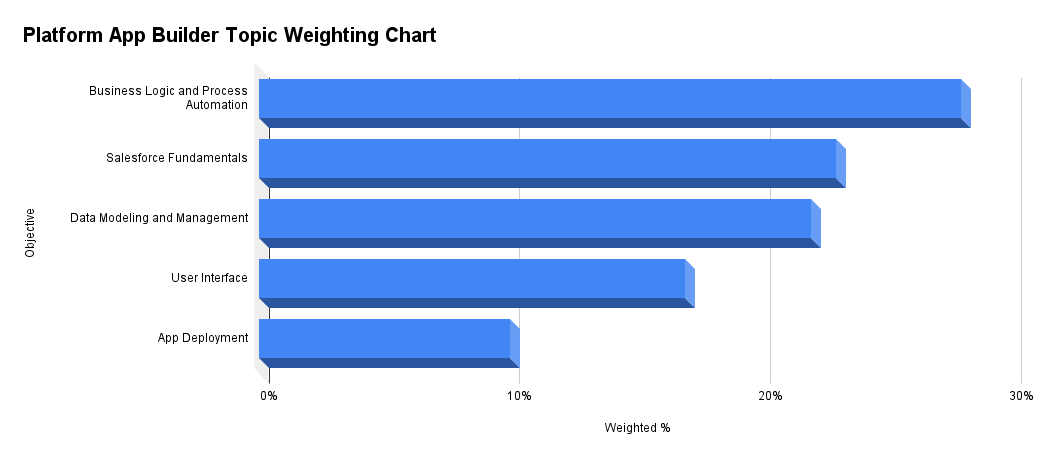
Five topics are covered in the Platform App Builder exam. The topic with the highest weighting is Business Logic and Process Automation as it is weighted at 28%. This is an area that must be focused on to do well in the exam.
Data table
| Objective | Weighting |
|---|---|
| App Deployment | 10% |
| User Interface | 17% |
| Data Modeling and Management | 22% |
| Salesforce Fundamentals | 23% |
| Business Logic and Process Automation | 28% |
Salesforce Platform App Builder Certification Contents
The following are the core topic areas of the Salesforce Platform App Builder certification and what test takers are expected to know:
Salesforce Fundamentals
In this section, test takers need to be familiar with the capabilities of the base objects and know the capabilities and use cases for declarative customizations versus programmatic solutions. It also includes knowing the use cases for using an AppExchange app.
As part of declaratively building or customizing an application, the appropriate level of an object, record, and field access for different types of users must always be kept in mind. This section will present scenarios and the test taker will need to determine the appropriate access and sharing solution, using features such as profile object access, permission sets, role hierarchy, sharing rules, manual sharing, and field-level security.
A fraction of this section also covers the features and capabilities of Salesforce reports, report types, and dashboards, using global, object-specific actions and layouts to optimize Salesforce experience, and Chatter use cases and configurations.

Data Modeling & Management
The Data Modeling and Management topic has the third-largest weighting in the exam, so test takers should spend time to be familiar with topic objectives. In order to pass the data modeling and management section of the Platform App Builder certification exam, test takers must be familiar with a variety of topics related to data management. These topics include being able to determine the appropriate data model given a scenario, the different relationship types and implications of selecting one on the user interface, reporting, and record access. In addition, the considerations for changing a field data type is also relevant.
The use cases and capabilities of external objects and when it is appropriate to use them as part of a data model design are discussed here. In order to work visually with the data model, a knowledge of schema builder is required. Finally, the options for importing and exporting data into and out of Salesforce, including the capabilities of external data sources are particularly covered by this section.
Business Logic & Process Automation
The Business Logic and Process Automation topic is the highest weighted section at 28. This topic requires the know-how to apply business logic to particular applications, using record types, formula fields, validation rules, and roll-up summary fields. Understanding the capabilities and use cases for the various automation tools, including Approval Processes, Workflow, Flow Builder, and Process Builder are also important.
One tricky topic under this section is knowing the possible solutions to automate business processes while avoiding errors. For example, the potential for field updates to cause recursion. Recursion is a valid programming technique, used when a method calls itself to solve a complex problem, however, it can cause a problem in Salesforce, if an update on one field triggers an update on another field which causes an update back on the first field, resulting in a recursive loop.

User Interface
In the User Interface section, test takers need to understand how to declaratively customize the user interface and when and how to use custom buttons, links, and actions. In addition, the knowledge on Lightning Components and how they can be incorporated into an application declaratively or programmatically are the main focus of this topic.

App Deployment
In this section, test takers need to be familiar with the options and best practices for deploying an application from a sandbox to production or from one org to another. This includes understanding the different types of sandboxes, different deployment tools, and when it is appropriate to use each tool for a particular type of deployment. Change sets are one way of deploying metadata from a sandbox. It is also important to understand the capabilities and role of packages in app development and deployment. Knowing the appropriate deployment tools based on given requirements are vital in devising an effective and efficient deployment plan.